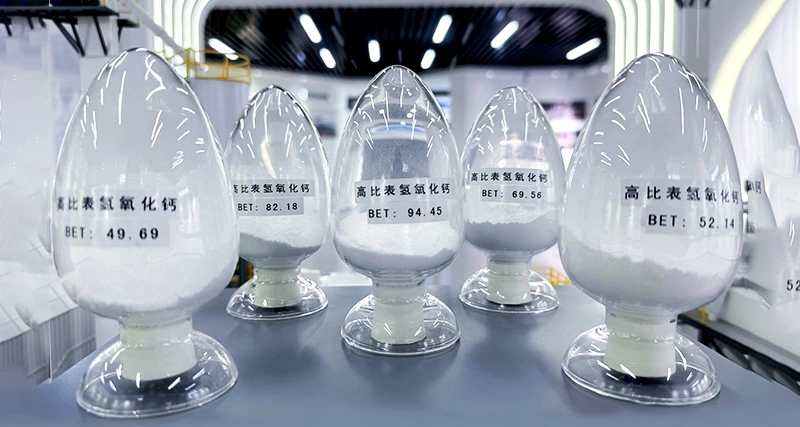
As national ecological and environmental policies continue to tighten, industrial green transformation accelerates, and governance standards across various sectors are constantly upgraded, high‑specific‑surface calcium hydroxide, as a green, efficient, and functional calcium‑based material, sees steadily expanding market demand, with broad prospects for industry development. In the future, it will continue to replace traditional low‑end lime and high‑cost chemical raw materials.
At the policy level, the state is steadily advancing environmental protection initiatives such as ultra‑low emissions from industrial flue gases, compliant treatment of wastewater, and ecological restoration of cultivated land, while strictly controlling the generation of hazardous waste and secondary pollution. Traditional baking soda and ordinary lime, due to their pronounced shortcomings, can no longer meet new standards or operating conditions. By contrast, high‑specific‑surface calcium hydroxide, with its green, environmentally friendly, highly efficient, low‑consumption, and zero‑hazardous‑waste characteristics, fully aligns with the nation’s green and low‑carbon development policies, making it the preferred environmentally friendly raw material supported by these policies.
In terms of market demand, in the industrial sector, industries such as power plants, steel, chemicals, and waste incineration continue to exhibit strong demand for desulfurization upgrades, while the markets for wastewater treatment and solid waste management are expanding steadily. In agriculture, the widespread adoption of soil acidification remediation and green farming practices further broadens the range of application scenarios for this product. The combined effect of multi‑sectoral demand is driving continuous growth in the market size of high‑specific‑surface calcium hydroxide.
On the technological front, industry production processes are undergoing continuous upgrades, with intelligent and precision‑oriented production lines gradually becoming more prevalent. Product stability and performance indicators are constantly being optimized, enabling the material to meet the needs of an increasing number of high‑end fine chemical and advanced environmental‑protection applications, thereby continuously enhancing its added value. Meanwhile, scaled‑up production is steadily reducing costs, making the product’s cost‑effectiveness even more pronounced and accelerating its rate of substitution.
In the future, the high‑specific‑surface calcium hydroxide industry will evolve toward greater refinement, higher-end positioning, greener practices, and customized solutions, with an ever‑expanding array of specialized products tailored to specific application scenarios. Leveraging its irreplaceable performance and cost advantages, this product will continue to dominate the mainstream market for calcium‑based environmental materials, serving as a core supporting material for industrial green development and ecological governance.